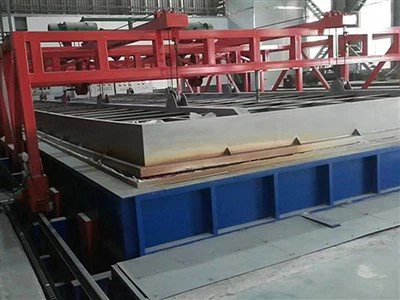


Product Definition and Core Functions
The Pit Furnace Liner (commonly referred to as a muffle pot or furnace retort) is the core sealed, load-bearing component of a pit-type furnace. Positioned as an independent vessel within the furnace chamber, its primary functions are:
· Creating a Controlled Atmosphere: It acts as a sealed barrier against external air, enabling oxidation-free and decarburization-free bright heat treatment of workpieces through vacuum extraction or the introduction of protective atmospheres (such as nitrogen or hydrogen).
· Uniform Heat Transfer: Serving as a heat transfer medium, it uniformly conveys heat from the furnace chamber to the workpieces housed inside.
· Workpiece Containment: It directly supports and contains various metal workpieces, wires, or strips awaiting heat treatment.
Structure and Material Design
The furnace liner typically consists of a cylindrical shell, a bottom head, and a flange; its design places a strong emphasis on both sealing integrity and heat resistance:
Main Body Material: It is predominantly constructed from austenitic heat-resistant stainless steel plates-such as 310S (offering superior temperature resistance) or 1Cr18Ni9Ti (321)-joined via precision welding. The plate thickness is determined by the specific dimensions of the liner and the intended operating temperature, typically ranging between 8 mm and 14 mm.
Structural Components:
Cylindrical Shell and Bottom:
It features a cylindrical body with a welded dished bottom head; this design eliminates "dead zones," thereby facilitating optimal gas circulation and ensuring uniform stress distribution.
Flange Sealing:
The upper flange undergoes precision machining and features a dual-channel sealing mechanism (e.g., an O-ring combined with a groove seal). This system works in conjunction with a water-cooled channel-which protects the sealing ring-to ensure the maintenance of high vacuum levels.
Hot Air Circulation:
When paired with the sealed circulation fan located on the furnace lid, it forces gas convection within the liner, thereby guaranteeing exceptional furnace temperature uniformity (achieving tolerances ranging from ±3°C to ±1°C).


Key Performance Advantages
High-Temperature Deformation Resistance:
Constructed from thick-walled, heat-resistant steel plates, the liner maintains excellent high-temperature structural integrity during prolonged operation within the 650°C to 950°C range, effectively resisting creep deformation and structural collapse.
Superior Sealing Performance:
Precision-machined flanges, paired with flexible graphite sealing rings or heat-resistant rubber gaskets, maintain a high degree of vacuum (e.g., 0.001 Torr), effectively preventing atmospheric leakage.
Surface Quality Preservation:
By isolating oxygen, the treated workpieces emerge with a smooth, bright finish that retains the metal's original luster, thereby eliminating the need for subsequent cleaning processes.
Excellent Temperature Uniformity:
Enhanced by forced hot air circulation, the working zone exhibits minimal temperature variation, ensuring consistent heat treatment results across an entire batch of workpieces.
Application Scenarios
Mechanical Heat Treatment: Vacuum tempering, bright annealing, and aging treatments for various alloy steel and carbon steel workpieces.
Non-ferrous Metal Processing: Oxygen-free bright annealing (typically requiring the introduction of a protective atmosphere) for materials such as copper wire, copper strip, and aluminum alloys.
Tools and Electronic Components: Low-oxidation or oxygen-free processing for precision parts, including measuring tools, cutting tools, and silicon steel laminations.


Selection Recommendations
When selecting a furnace, priority should be given to:
the grade of heat-resistant steel (which determines the maximum operating temperature and service life),the plate thickness (which determines structural strength), and the flange sealing mechanism (which determines the ultimate vacuum level).
Regular removal of scale and carbon deposits from the inner walls of the furnace chamber is critical for maintaining heat transfer efficiency and extending the equipment's service life.
Hot Tags: pit furnace liner, China pit furnace liner, furnace accessories, Pit Furnace Liner, Rotary Furnace Liner