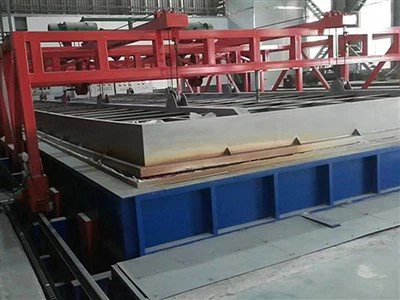
What are the air flow patterns in a Bogie Hearth Furnace?
As a trusted supplier of Bogie Hearth Furnaces, I've had the privilege of witnessing the intricate dance of air within these remarkable industrial workhorses. Airflow patterns in a Bogie Hearth Furnace are not just a technicality; they are the lifeblood that ensures efficient and uniform heat treatment. In this blog, we'll delve into the science behind these airflow patterns, exploring how they impact the performance and capabilities of our furnaces.
Understanding the Basics of Airflow in a Bogie Hearth Furnace
At the heart of a Bogie Hearth Furnace, the airflow serves multiple crucial functions. It helps in distributing heat evenly throughout the chamber, ensuring that every part of the load receives the same level of thermal treatment. This uniformity is essential for achieving consistent product quality, whether you're annealing, hardening, or tempering metal components.
The airflow in a Bogie Hearth Furnace is typically driven by one or more fans. These fans create a forced convection environment, where the air is circulated within the furnace chamber at a controlled rate. The direction and intensity of the airflow can be adjusted to meet the specific requirements of different heat treatment processes.
Types of Airflow Patterns
There are primarily two types of airflow patterns commonly observed in Bogie Hearth Furnaces: vertical and horizontal.
Vertical Airflow
In a vertical airflow pattern, the air is circulated from the bottom to the top of the furnace chamber. This type of airflow is particularly effective for applications where a high degree of heat transfer is required. The rising hot air carries the heat upwards, ensuring that the upper part of the load receives sufficient thermal energy. Vertical airflow is often used in processes such as normalizing and stress relieving, where uniform heating is crucial.
Horizontal Airflow
Horizontal airflow, on the other hand, involves the circulation of air from one side of the furnace chamber to the other. This pattern is ideal for applications where the load is placed horizontally, such as in the case of flat metal sheets or large components. Horizontal airflow helps in achieving a more even distribution of heat across the width of the load, reducing the risk of thermal gradients and ensuring consistent treatment.
Factors Affecting Airflow Patterns
Several factors can influence the airflow patterns in a Bogie Hearth Furnace. These include the design of the furnace, the type and size of the load, and the operating conditions.
Furnace Design
The design of the furnace plays a crucial role in determining the airflow patterns. Factors such as the shape and size of the chamber, the location of the fans, and the presence of baffles or ducts can all affect how the air circulates within the furnace. A well-designed furnace will have a balanced airflow system that ensures efficient heat transfer and uniform temperature distribution.
Load Characteristics
The type and size of the load also have a significant impact on the airflow patterns. A large, dense load may impede the airflow, causing uneven heating. In such cases, it may be necessary to adjust the airflow rate or direction to ensure that the load is heated evenly. Additionally, the arrangement of the load within the furnace can also affect the airflow. For example, stacking the load too closely together can restrict the movement of air, while leaving sufficient space between the components can promote better circulation.
Operating Conditions
The operating conditions, such as the temperature and pressure within the furnace, can also influence the airflow patterns. Higher temperatures can cause the air to expand, which may affect the circulation rate. Similarly, changes in pressure can alter the direction and intensity of the airflow. It is important to monitor and control these operating conditions to ensure optimal airflow and heat treatment performance.
Benefits of Optimized Airflow Patterns
Optimizing the airflow patterns in a Bogie Hearth Furnace offers several benefits, including:
Improved Heat Transfer
Efficient airflow ensures that the heat is transferred more effectively from the heating elements to the load. This results in faster heating and cooling times, reducing the overall processing time and increasing productivity.
Uniform Temperature Distribution
A well-designed airflow system helps in achieving a more uniform temperature distribution within the furnace chamber. This ensures that all parts of the load are heated and cooled at the same rate, minimizing the risk of thermal stress and distortion.


Enhanced Product Quality
Consistent heat treatment is essential for achieving high-quality products. By optimizing the airflow patterns, we can ensure that the load is treated uniformly, resulting in improved mechanical properties and dimensional accuracy.
Energy Efficiency
Optimized airflow patterns can also contribute to energy efficiency. By ensuring that the heat is distributed evenly, we can reduce the amount of energy required to maintain the desired temperature within the furnace. This not only saves on energy costs but also reduces the environmental impact of the heat treatment process.
Other Related Industrial Furnaces
In addition to Bogie Hearth Furnaces, we also offer a range of other industrial furnaces, each with its own unique airflow patterns and applications. These include Pit Type Industrial Furnace, Well Type Industrial Furnace, and Mesh Belt Industrial Furnace. Each of these furnaces is designed to meet the specific needs of different industries and heat treatment processes.
Contact Us for Your Furnace Needs
If you're in the market for a high-quality Bogie Hearth Furnace or any other industrial furnace, we're here to help. Our team of experts has extensive experience in designing and manufacturing furnaces that meet the highest standards of quality and performance. We can work with you to understand your specific requirements and recommend the best furnace solution for your application.
Contact us today to discuss your furnace needs and start the process of purchasing a reliable and efficient industrial furnace. We look forward to working with you to achieve your heat treatment goals.
References
- Smith, J. (2018). Industrial Furnace Design and Operation. Elsevier.
- Jones, A. (2019). Heat Treatment Processes and Equipment. Wiley.
- Brown, R. (2020). Airflow Analysis in Industrial Furnaces. Journal of Thermal Engineering, 6(2), 123-135.