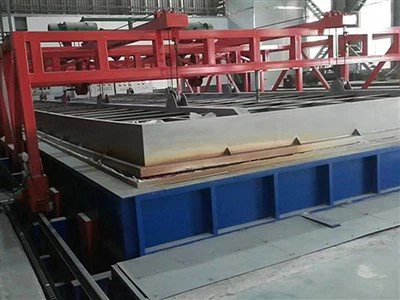
Industrial furnaces play a crucial role in various manufacturing processes, providing the high temperatures necessary for operations such as heat treatment, melting, and sintering. Among the different types of industrial furnaces available in the market, the Mesh Belt Industrial Furnace stands out due to its unique design and functionality. In this blog, we will explore the differences between a Mesh Belt Industrial Furnace and other common types of industrial furnaces, such as Horizontal Industrial Furnace, Pit Type Industrial Furnace, and Bogie Type Furnace. As a prominent Mesh Belt Industrial Furnace supplier, we have in - depth knowledge of these furnaces and are well - placed to draw these comparisons.
Design and Structure
One of the most apparent differences lies in the design and structure of these furnaces. A Mesh Belt Industrial Furnace features a continuous mesh belt that conveys the workpieces through the heating chamber. The mesh belt is usually made of heat - resistant alloy, which can withstand high temperatures and is highly durable. This design allows for a continuous and automated process, where workpieces can be loaded at one end of the belt and unloaded at the other end after undergoing the necessary heat treatment.
In contrast, a Horizontal Industrial Furnace typically has a horizontal chamber with doors at one or both ends. Workpieces are loaded into the chamber manually or with the help of a conveyor system. The horizontal layout provides a straightforward access for loading and unloading large or heavy workpieces. However, it may not offer the same level of continuous processing as a Mesh Belt Industrial Furnace.
A Pit Type Industrial Furnace is designed with a vertical chamber that is sunk into the ground. This design is suitable for heat - treating long or tall workpieces that need to be suspended vertically. Loading and unloading are often done using a crane or a hoist. The pit - type structure helps in minimizing heat loss and provides a stable environment for heat treatment. But it has limitations in terms of the shape and size of the workpieces that can be processed compared to a Mesh Belt Industrial Furnace, which is more versatile in handling various small to medium - sized parts.
A Bogie Type Furnace consists of a movable bogie or platform that can be rolled in and out of the furnace chamber. This is useful for heat - treating large and heavy workpieces, as the bogie can be loaded outside the furnace and then moved inside. The bogie design allows for easy access to the workpieces and can handle irregularly shaped items. Nevertheless, it is a batch - type process, which means that the furnace has to be heated up and cooled down for each batch, resulting in longer processing times compared to the continuous operation of a Mesh Belt Industrial Furnace.
Processing Capacity and Throughput
The processing capacity and throughput are important factors to consider when choosing an industrial furnace. A Mesh Belt Industrial Furnace excels in high - volume production. The continuous movement of the mesh belt allows for a constant flow of workpieces through the furnace, enabling a high throughput rate. This makes it ideal for mass - producing small to medium - sized parts, such as fasteners, bearings, and automotive components.
The Horizontal Industrial Furnace can handle a relatively large number of workpieces in a single batch, depending on the size of its chamber. However, since it is a batch - type operation, the overall throughput may be lower compared to a Mesh Belt Industrial Furnace, especially for high - volume production. The time required for loading, heating, soaking, and unloading each batch can add up, reducing the overall efficiency.
A Pit Type Industrial Furnace is usually used for processing a limited number of large or long workpieces at a time. Its vertical design restricts the number of workpieces that can be loaded simultaneously. The throughput of a pit - type furnace is generally lower than that of a Mesh Belt Industrial Furnace and is more suitable for applications where the quantity of parts is not extremely high, but the size and shape requirements are specific.
The Bogie Type Furnace also has a batch - type processing nature. Although it can handle large and heavy workpieces, the time taken for heating up and cooling down the furnace between batches can significantly affect the throughput. For industries that require a high - volume production of small parts, a Mesh Belt Industrial Furnace is a much better choice.
Temperature Uniformity
Temperature uniformity is critical in heat - treatment processes to ensure consistent quality of the workpieces. A Mesh Belt Industrial Furnace is designed to provide excellent temperature uniformity across the width and length of the heating chamber. The mesh belt allows for good air circulation around the workpieces, which helps in distributing the heat evenly. Additionally, advanced control systems can be integrated into the furnace to monitor and adjust the temperature precisely.
In a Horizontal Industrial Furnace, achieving uniform temperature can be more challenging, especially in larger chambers. The presence of doors at the ends can cause heat leakage, leading to temperature variations within the chamber. Special design features, such as efficient insulation and proper air - flow management, are required to improve temperature uniformity.
A Pit Type Industrial Furnace can have good temperature stability due to its vertical and enclosed structure. However, the vertical shape may result in temperature gradients from the top to the bottom of the chamber, which need to be carefully controlled. The use of multiple heating elements and proper insulation can help in minimizing these gradients.
The Bogie Type Furnace may face challenges in maintaining temperature uniformity, especially when loading large or irregularly shaped workpieces. The movement of the bogie in and out of the furnace can also cause temporary temperature fluctuations. Adequate heating controls and insulation are necessary to ensure that the workpieces are heated uniformly.
Energy Efficiency
Energy efficiency is a major concern for industries, as it directly affects production costs. Mesh Belt Industrial Furnaces are often more energy - efficient for continuous - production processes. Since the furnace does not need to be heated up and cooled down for each batch, there is less energy wasted during these cycles. Additionally, the efficient heat - transfer design of the mesh belt and the ability to recover waste heat can further reduce energy consumption.
The Horizontal Industrial Furnace may consume more energy in batch - type operations. The repeated heating and cooling cycles can lead to significant energy losses. To improve energy efficiency, advanced insulation materials and heat - recovery systems can be installed, but these may add to the initial cost of the furnace.
A Pit Type Industrial Furnace can be relatively energy - efficient due to its enclosed structure, which reduces heat loss. However, the large mass of the furnace and the workpieces inside may require more energy to reach the desired temperature initially. Energy - saving measures, such as using high - efficiency heating elements and insulation, are essential to optimize its energy consumption.
The Bogie Type Furnace also has energy - consumption challenges associated with batch - type processing. The heating and cooling of the furnace and the bogie between batches can be energy - intensive. Implementing energy - recovery systems and improving insulation can help in reducing energy costs, but the overall energy efficiency may still be lower compared to a Mesh Belt Industrial Furnace for high - volume production.
Maintenance and Operational Flexibility
Mesh Belt Industrial Furnaces are relatively easy to maintain. The mesh belt can be inspected and replaced easily if damaged. The automated nature of the operation reduces the need for manual intervention, which means less wear and tear on components. Moreover, they offer high operational flexibility as the speed of the mesh belt can be adjusted to control the dwell time of the workpieces in the furnace, allowing for different heat - treatment processes.


The Horizontal Industrial Furnace requires regular inspection of the doors and seals to prevent heat leakage. The conveyor system, if used, also needs maintenance. Its operational flexibility is somewhat limited compared to a Mesh Belt Industrial Furnace, as the batch - type operation may require more time for changeovers between different workpieces.
A Pit Type Industrial Furnace requires careful maintenance of the hoisting equipment and the heating elements. Access to the interior of the furnace for maintenance can be more difficult due to its vertical design. In terms of operational flexibility, it is mainly suitable for specific types of workpieces and may not be as adaptable to different production requirements as a Mesh Belt Industrial Furnace.
The Bogie Type Furnace needs regular maintenance of the bogie wheels, bearings, and the heating system. The batch - type operation limits its flexibility in quickly changing the production process. It may take more time to adjust the furnace settings for different workpieces compared to a Mesh Belt Industrial Furnace.
Conclusion
In summary, a Mesh Belt Industrial Furnace offers several advantages over other types of industrial furnaces, such as Horizontal Industrial Furnace, Pit Type Industrial Furnace, and Bogie Type Furnace. Its continuous - processing nature, high throughput, excellent temperature uniformity, energy efficiency, and ease of maintenance make it a preferred choice for high - volume production of small to medium - sized parts. However, the choice of an industrial furnace ultimately depends on the specific requirements of the manufacturing process, such as the type, size, and quantity of workpieces, as well as the desired heat - treatment processes.
If you are in the market for an industrial furnace and are considering the benefits of a Mesh Belt Industrial Furnace, we invite you to contact us for further discussion. Our team of experts can provide you with detailed information, customized solutions, and a competitive quote based on your specific needs. Let's start a conversation to find the best furnace solution for your production requirements.
References
- Smith, J. (2018). Industrial Furnace Technology. New York: Industrial Press.
- Johnson, A. (2020). Heat Treatment Processes and Furnaces. London: Elsevier.