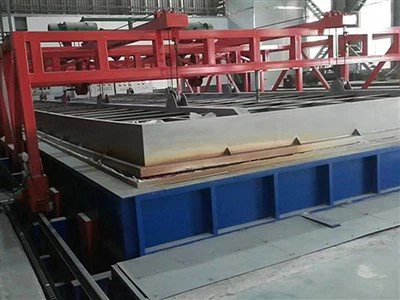
Enhancing convection heat transfer in a horizontal industrial furnace is crucial for improving energy efficiency, reducing processing times, and ensuring uniform heating across the load. As a leading supplier of Horizontal Industrial Furnace, we understand the significance of optimizing heat transfer mechanisms in industrial settings. In this blog post, we will explore various strategies and techniques to enhance convection heat transfer in horizontal industrial furnaces, providing practical insights and solutions for industrial operators.


Understanding Convection Heat Transfer in Horizontal Industrial Furnaces
Convection heat transfer occurs when heat is transferred through the movement of a fluid, such as air or a gas, over a heated surface. In a horizontal industrial furnace, convection plays a vital role in distributing heat evenly throughout the furnace chamber, ensuring that the load is heated uniformly. There are two main types of convection: natural convection and forced convection.
- Natural Convection: Natural convection occurs when the fluid motion is driven by density differences caused by temperature variations. In a horizontal industrial furnace, natural convection currents are created as the heated air near the furnace walls rises and cooler air from the surrounding areas rushes in to replace it. While natural convection can provide some degree of heat transfer, it is often limited in its effectiveness, especially in larger furnaces or when high heating rates are required.
- Forced Convection: Forced convection involves the use of mechanical means, such as fans or blowers, to enhance the fluid motion and increase the heat transfer rate. By forcing the air or gas to flow over the heated surface at a higher velocity, forced convection can significantly improve the heat transfer efficiency and reduce the heating time.
Strategies to Enhance Convection Heat Transfer
1. Optimize Furnace Design
- Furnace Geometry: The shape and size of the furnace chamber can have a significant impact on convection heat transfer. A well-designed furnace should have a uniform cross-sectional area and smooth interior surfaces to minimize flow resistance and promote efficient fluid circulation. Additionally, the placement of heating elements and baffles can be optimized to direct the flow of air or gas over the load, ensuring uniform heating.
- Airflow Pathways: Designing proper airflow pathways within the furnace is essential for enhancing convection heat transfer. This can be achieved by incorporating baffles, ducts, or diffusers to control the direction and velocity of the air or gas flow. By creating a well-defined airflow pattern, heat can be distributed more evenly throughout the furnace chamber, reducing hot spots and improving overall heating efficiency.
2. Increase Air Velocity
- Fans and Blowers: Installing high-performance fans or blowers is one of the most effective ways to increase air velocity and enhance forced convection heat transfer. By increasing the airflow rate, the heat transfer coefficient can be significantly improved, resulting in faster heating and more uniform temperature distribution. When selecting fans or blowers, it is important to consider factors such as the furnace size, load requirements, and desired airflow rate.
- Nozzle Design: The design of the nozzles used to introduce air or gas into the furnace can also affect the air velocity and heat transfer efficiency. Nozzles with a narrow opening and high exit velocity can create a high-velocity jet of air or gas, which can enhance the mixing and heat transfer between the fluid and the load. Additionally, the placement and orientation of the nozzles can be optimized to ensure that the airflow is directed towards the areas of the load that require the most heat.
3. Improve Heat Transfer Surfaces
- Surface Area: Increasing the surface area of the heating elements or the load can enhance convection heat transfer by providing more contact area for the fluid to exchange heat. This can be achieved by using finned heating elements or by increasing the surface roughness of the load. Finned heating elements have a larger surface area than traditional heating elements, which allows for more efficient heat transfer to the surrounding fluid.
- Surface Coating: Applying a high-emissivity coating to the heating elements or the furnace walls can also improve heat transfer efficiency. High-emissivity coatings have a higher ability to emit and absorb thermal radiation, which can enhance the heat transfer between the surface and the fluid. Additionally, these coatings can reduce the formation of scale and corrosion on the surface, which can further improve the heat transfer performance.
4. Control Furnace Atmosphere
- Gas Composition: The composition of the gas inside the furnace can have a significant impact on convection heat transfer. By using a gas with a high thermal conductivity, such as hydrogen or helium, the heat transfer rate can be increased. Additionally, the presence of certain gases, such as oxygen or water vapor, can affect the oxidation and corrosion of the load and the furnace components, which can also impact the heat transfer performance.
- Pressure and Temperature: Maintaining the proper pressure and temperature inside the furnace is essential for optimizing convection heat transfer. By controlling the pressure and temperature, the density and viscosity of the gas can be adjusted, which can affect the fluid flow and heat transfer characteristics. Additionally, maintaining a stable furnace atmosphere can help to prevent the formation of hot spots and ensure uniform heating across the load.
Case Studies and Examples
To illustrate the effectiveness of these strategies, let's consider a few case studies of horizontal industrial furnaces where convection heat transfer has been enhanced.
- Case Study 1: Bogie Type Furnace Optimization
- A manufacturing company was experiencing long heating times and uneven temperature distribution in their bogie type furnace. By installing high-performance fans and optimizing the airflow pathways, the company was able to increase the air velocity and improve the convection heat transfer. As a result, the heating time was reduced by 30%, and the temperature uniformity across the load was improved.
- Case Study 2: Bogie Hearth Furnace Retrofit
- Another company retrofitted their bogie hearth furnace with finned heating elements and a high-emissivity coating. This modification increased the surface area of the heating elements and improved the heat transfer efficiency. The company observed a 20% reduction in energy consumption and a significant improvement in the quality of the heat-treated products.
Conclusion
Enhancing convection heat transfer in a horizontal industrial furnace is essential for improving energy efficiency, reducing processing times, and ensuring uniform heating across the load. By optimizing the furnace design, increasing air velocity, improving heat transfer surfaces, and controlling the furnace atmosphere, industrial operators can significantly enhance the performance of their horizontal industrial furnaces. As a leading supplier of Horizontal Industrial Furnace, we are committed to providing our customers with innovative solutions and technologies to optimize heat transfer in their industrial processes. If you are interested in learning more about how we can help you enhance convection heat transfer in your horizontal industrial furnace, please contact us to discuss your specific requirements and explore our range of products and services.
References
- Incropera, F. P., & DeWitt, D. P. (2002). Fundamentals of heat and mass transfer. John Wiley & Sons.
- Holman, J. P. (2002). Heat transfer. McGraw-Hill.
- Kreith, F., Manglik, R. M., & Bohn, M. S. (2011). Principles of heat transfer. Cengage Learning.