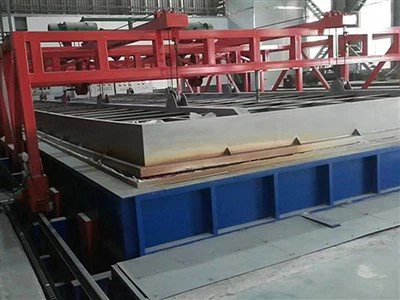
In the forging industry, heat treatment equipment plays a pivotal and multi - faceted role. As a heat treatment equipment supplier, I have witnessed firsthand how these machines are the backbone of the forging process, contributing significantly to the quality, performance, and efficiency of forged products.
Improving Material Properties
One of the primary functions of heat treatment equipment in the forging industry is to enhance the mechanical properties of metals. Through processes such as annealing, quenching, and tempering, the internal structure of the metal can be precisely controlled.
Annealing is a heat treatment process that involves heating the metal to a specific temperature and then cooling it slowly. This process relieves internal stresses, refines the grain structure, and improves the ductility and machinability of the metal. For example, in the production of large - scale forged shafts for the automotive industry, annealing can reduce the risk of cracking during subsequent machining operations.
Quenching, on the other hand, is a rapid cooling process that increases the hardness of the metal. By heating the metal to a high temperature and then quickly cooling it in a quenching medium such as oil or water, the metal's crystal structure is transformed into a harder and more brittle form. However, quenching can also introduce internal stresses, which is why tempering is often performed afterward. Tempering involves reheating the quenched metal to a lower temperature and then cooling it slowly. This process reduces the brittleness of the quenched metal while retaining its hardness, improving its toughness and fatigue resistance.


Ensuring Product Quality and Consistency
Heat treatment equipment is essential for ensuring the quality and consistency of forged products. In the forging industry, even small variations in the heat treatment process can have a significant impact on the final properties of the product. Modern heat treatment equipment is equipped with advanced control systems that can precisely regulate the temperature, time, and atmosphere during the heat treatment process.
For instance, the Roller Hearth Heat Treatment Equipment is designed to provide uniform heating and cooling, ensuring that all parts of the forged component receive the same treatment. This uniformity is crucial for maintaining consistent mechanical properties across a batch of products. By using such equipment, forging companies can reduce the rejection rate and improve the overall quality of their products.
Increasing Production Efficiency
Efficiency is a key factor in the forging industry, and heat treatment equipment can play a vital role in improving it. Advanced heat treatment equipment is designed to have a high throughput, allowing for a large number of forged components to be processed in a relatively short period.
The Rotary Heat Treatment Equipment is an example of such equipment. It features a rotating chamber that allows for continuous loading and unloading of forged parts, minimizing downtime and increasing productivity. Additionally, modern heat treatment equipment often uses energy - efficient technologies, such as regenerative burners and insulation materials, to reduce energy consumption and operating costs.
Adapting to Different Forging Requirements
The forging industry encompasses a wide range of products, from small precision components to large - scale industrial parts. Heat treatment equipment needs to be flexible enough to adapt to the different requirements of these products.
Vertical Heat Treatment Equipment is particularly suitable for heat - treating long and slender forged parts, such as rods and tubes. The vertical design allows for better control of the heating and cooling process, ensuring that the parts are treated evenly. Different types of heat treatment equipment can be customized to meet the specific needs of different forging applications, whether it is a high - volume production environment or a specialized, low - volume job.
Cost - effectiveness and Return on Investment
Investing in high - quality heat treatment equipment can provide significant cost - savings in the long run. Although the initial investment may be substantial, the improved product quality, increased production efficiency, and reduced scrap rates can lead to a higher return on investment.
By using heat treatment equipment to optimize the properties of forged products, forging companies can reduce the need for additional machining and finishing operations, saving both time and money. Moreover, the enhanced mechanical properties of the heat - treated products can increase their market value, allowing for higher profit margins.
Environmental Considerations
In today's world, environmental sustainability is an important consideration in the forging industry. Heat treatment equipment can contribute to environmental protection in several ways.
Modern heat treatment equipment is designed to be more energy - efficient, reducing the carbon footprint of the forging process. Additionally, some heat treatment processes can use environmentally friendly quenching media, such as biodegradable oils, to minimize the impact on the environment. By investing in sustainable heat treatment equipment, forging companies can not only meet environmental regulations but also enhance their corporate social responsibility.
Conclusion
In conclusion, heat treatment equipment is an indispensable part of the forging industry. It plays a crucial role in improving material properties, ensuring product quality and consistency, increasing production efficiency, adapting to different forging requirements, providing cost - effectiveness, and considering environmental factors.
As a heat treatment equipment supplier, we are committed to providing high - quality, innovative, and sustainable solutions to meet the diverse needs of the forging industry. If you are interested in learning more about our heat treatment equipment or would like to discuss your specific forging requirements, we encourage you to reach out to us for a detailed consultation. We look forward to the opportunity to work with you and contribute to the success of your forging operations.
References
- ASM Handbook Committee. (2001). ASM Handbook, Volume 4: Heat Treating. ASM International.
- Totten, G. E., & Howes, M. A. (2006). Handbook of Quenchants and Quenching Technology. CRC Press.
- Davis, J. R. (2001). Heat Treating Principles and Processes. ASM International.